
 Tailings dams don’t fail because engineers are lazy. They fail because water is a terrible structural material. Every cubic meter of water you store behind a tailings embankment is a cubic meter that wants to move, seep, liquefy, and eventually find a way out. That is the ugly truth the mining industry has been slow to confront. Paste backfill technology doesn’t just confront it. It turns the problem into an asset.
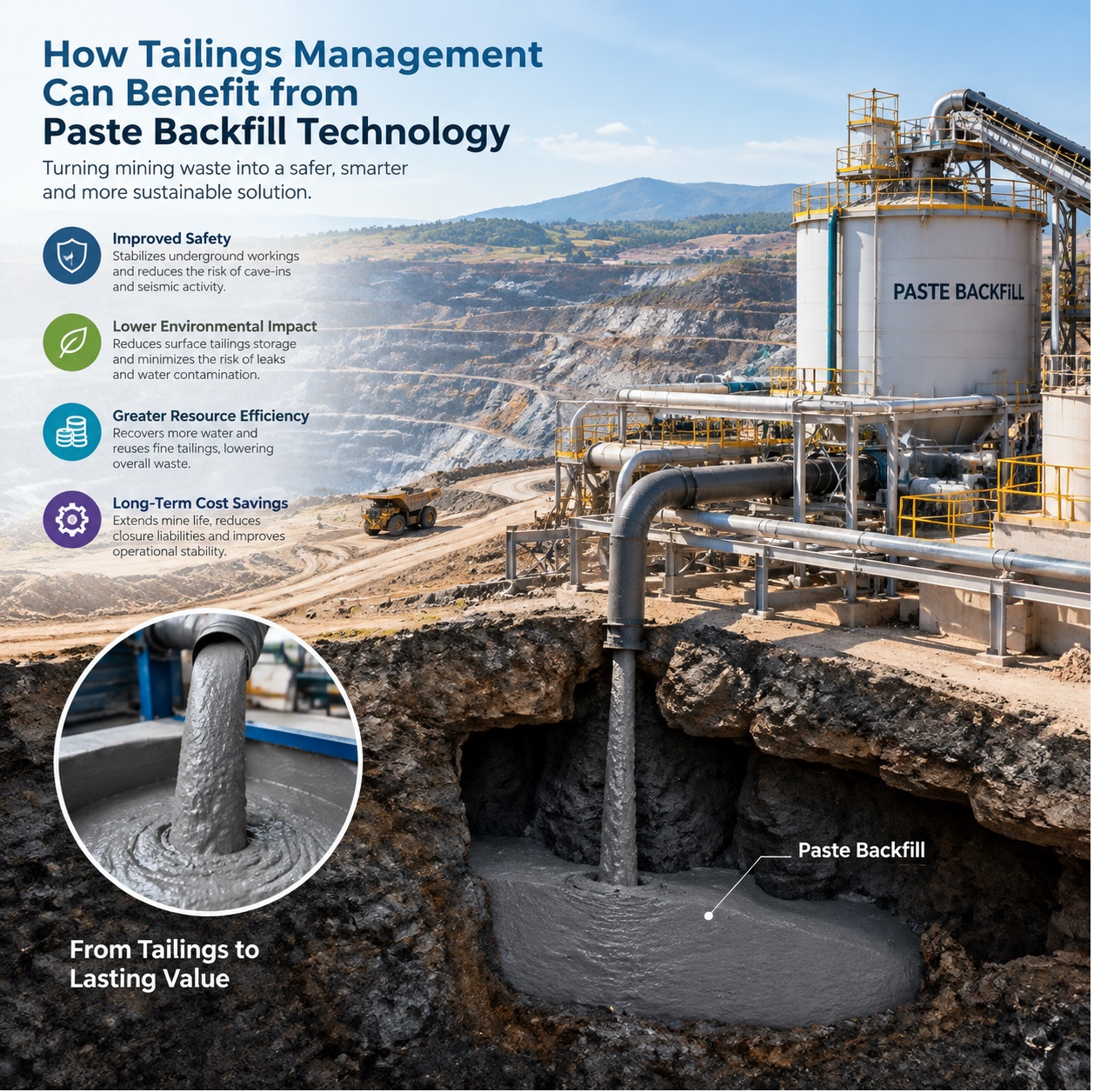
For years, tailings management has been treated as a cost center: build a dam, raise the dam, monitor the dam, pray the dam holds. Then a regulator shows up, a community group asks hard questions, or an investor notices the liability sitting on the balance sheet. Suddenly the cheapest option looks expensive. Paste backfill offers a different route. Instead of storing all your tailings on the surface, you mix them with a binder and water to create a thick, non-settling paste. Then you pump that paste underground to fill mined-out voids. The tailings stay where they came from. The surface stays safer. And the underground workings get stronger.
What does that mean for tailings management? Start with volume. A paste backfill system can significantly reduce the amount of tailings sent to a surface impoundment. Depending on the orebody, the grind size, the binder dosage, and how much void space you have underground, operators often see surface tailings volumes drop by 30% to 60%. In some cases, mines can eliminate the need for a new dam raise or postpone it for years. That is not a minor accounting adjustment. Dam raises are capital-intensive, permit-heavy, and politically radioactive. Every cubic meter you place underground is a cubic meter you don’t have to manage, monitor, and insure on the surface.
Water is the next win. Conventional tailings slurries are mostly water. That water has to be pumped, recycled, treated, and contained. In arid regions, it is the difference between a viable operation and a shutdown risk. Paste backfill uses far less water because the paste is designed to be high-density and non-bleeding. The water you do use stays in the mix or is recovered underground. For mines facing water scarcity or strict discharge limits, that alone can justify the investment. You are not just managing tailings. You are managing a scarce resource.
Then there is the geotechnical story. Paste backfill fills voids and supports the rock mass. That means less subsidence, less dilution, and better ground control. In underground mines, that translates into safer working conditions and more stable stopes. It can also unlock ore that would otherwise be left behind as pillars. If you can recover pillars with paste backfill, you are converting a liability into production. That is the kind of math that gets a CFO’s attention. The tailings are no longer waste. They are a structural material with a revenue story attached.
Surface footprint matters too. Every tailings storage facility carries a long tail of costs: construction, liner systems, seepage collection, dust control, wildlife protection, closure, and perpetual monitoring. Paste backfill shrinks that footprint. It reduces the number of dams, the height of dams, and the volume of water stored behind them. That lowers the consequence of a failure, which lowers the regulatory and reputational risk. In a world where investors screen for ESG performance and communities organize against new impoundments, a smaller surface footprint is not just nice to have. It is a competitive advantage.
Let’s talk about the money, because that is where marketing fluff usually falls apart. Paste backfill has upfront costs: a paste plant, binder handling, pumping infrastructure, and underground distribution. Binder is the biggest operating cost. Cement and slag are not cheap. If you ignore that, you are selling a fantasy. The real question is total cost of ownership. Compare the paste system against the full lifecycle of a tailings dam: land acquisition, construction, raises, water management, regulatory compliance, closure, and long-term liability. In many cases, the paste option wins. It wins faster when you factor in pillar recovery, reduced dilution, lower water treatment costs, and avoided permitting delays. It wins even faster when you consider the cost of a tailings dam failure. No insurance policy can fix a broken community trust.
Permitting and social license are where paste backfill quietly outperforms. Regulators are increasingly skeptical of large surface impoundments. Communities are tired of being downstream of someone else’s risk. A mine that can demonstrate it is putting tailings back underground, reducing water storage, and shrinking its surface footprint has a stronger story. That story does not guarantee approval, but it changes the conversation. Instead of defending a dam, you are explaining a closed-loop system. That is a much better position to be in.
None of this means paste backfill is a universal fix. Geology matters. Not every mine has enough underground voids. Not every tailings stream is compatible with paste production. Binder costs can make or break the business case. You need a proper lab program, a pilot plant, and a realistic simulation of underground placement. The technology is proven, but it is not plug-and-play. The mines that get the most value treat paste backfill as an integrated part of mine planning, not a bolt-on afterthought.
That is the real shift. Tailings management has been reactive for too long. Paste backfill makes it proactive. It turns a waste stream into a support system. It turns a surface liability into underground strength. It turns water risk into water savings. It turns community opposition into a credible sustainability narrative. For an industry under pressure to produce more, pollute less, and prove it can operate safely, that is not a niche technical upgrade. It is a strategic advantage.
If your tailings strategy is still “build it higher and hope,” you are not managing risk. You are financing it. Paste backfill technology gives you a way to move the problem out of the dam and into the mine plan, where you can control it, measure it, and turn it into value. That is how tailings management stops being a headache and starts being a lever.