
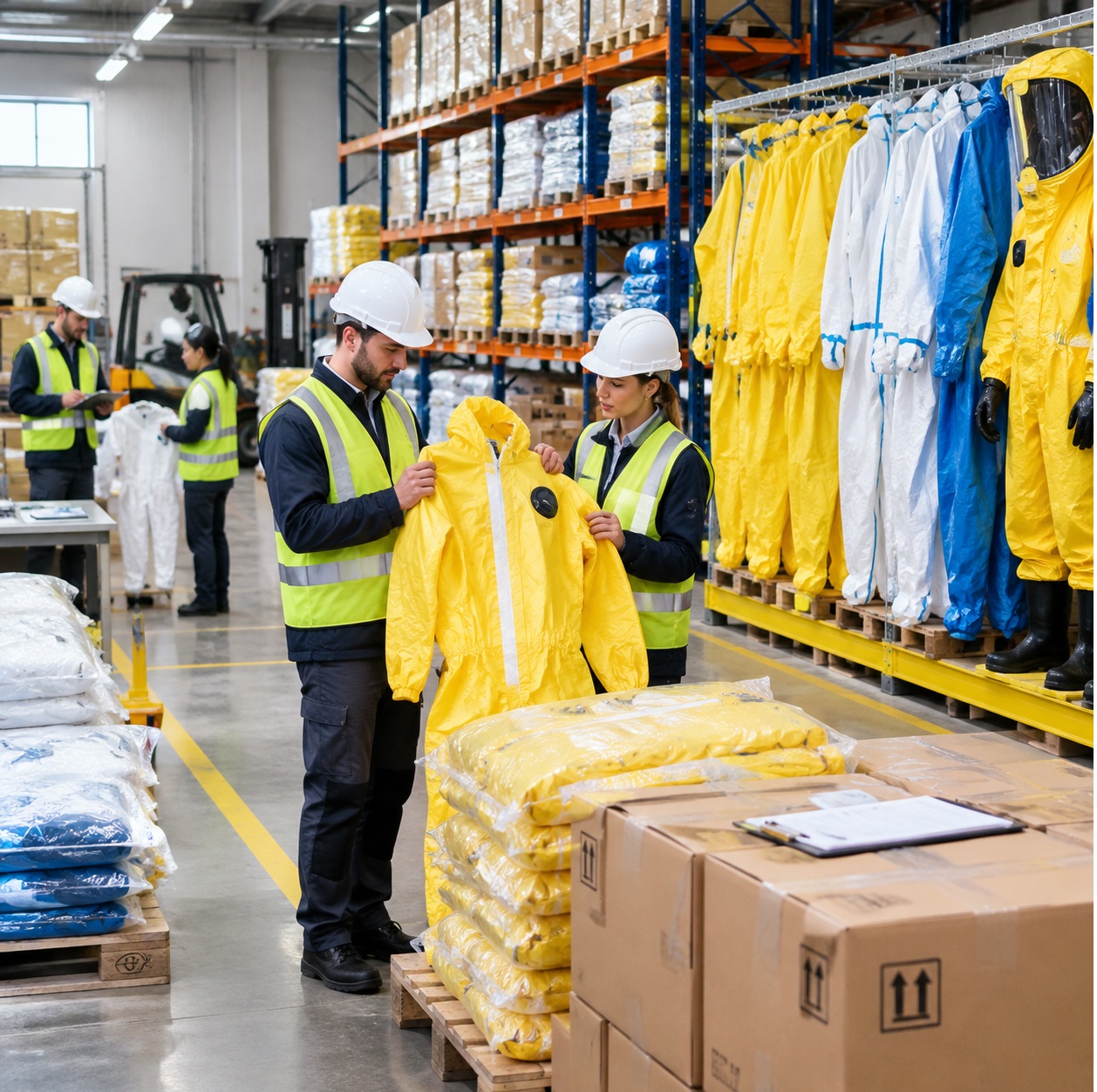
 Most safety managers don’t get burned by the suit. They get burned by the purchase order.
One suit is a decision you can undo. Four hundred suits is a commitment that sits in your warehouse for the next five years, ties up budget, and either protects your people or becomes the exhibit in an incident investigation. So the question of where to buy in bulk isn’t really about finding a website with a shopping cart. It’s about finding a supply chain you can defend.
Start with the hazard, not the vendor
Before you talk to a single supplier, know what you’re actually buying. A Type 6 suit for light splash protection costs a fraction of a Type 3 suit with taped seams, and mixing them up across a bulk order is how teams end up overpaying for one crew and under-protecting another. Pull the SDS for every chemical your team handles, check the permeation and degradation data against the specific suit model, and write down the standard you need: EN 943 for gas-tight, EN 14605 for liquid-tight and spray-tight, EN ISO 13982 for particle protection, EN 13034 for limited splash, NFPA 1991 or 1992 for the North American equivalents.
Do this first. Because once you’re negotiating 500 units, nobody on the other side of the table is going to talk you out of a bad spec.
Channel one: straight to the manufacturer
If your annual volume is real, this is where the money is. Factory-direct pricing typically lands 20 to 40 percent below distributor list, and at volume you can negotiate things that matter more than price: custom sizing runs, reinforced knee and elbow panels, your site’s color coding, individual polybagging with printed instructions, and lot-specific test documentation.
The trade-offs are honest ones. Minimum order quantities usually start around 100 to 200 units for stock styles and climb sharply for anything custom. Lead times run 45 to 90 days, sometimes longer if you’re importing. You handle freight, customs, and duty yourself, or you hire someone who does. And you get zero hand-holding when a shipment arrives with a zipper issue.
Before you wire a deposit, ask for the factory’s ISO 9001 certificate, the notified body number behind the CE marking, and third-party test reports from a lab you recognize. Then ask whether they’ll allow an inspection before shipment. Suppliers who resist that last question are telling you something.
Channel two: authorized distributors and PPE wholesalers
This is the pragmatic middle. You pay 10 to 25 percent more than factory-direct, but you get brand-name suits with traceable certification, local stock, technical support from people who know the product line, and return terms that don’t require a shipping container to make sense.
Minimums are friendlier here, often 24 to 100 units per size. If your team needs to replenish quarterly rather than buy a year at once, a distributor relationship usually beats a factory relationship on total cost, because you’re not warehousing a five-year supply in a room that gets hot in July.
Channel three: B2B marketplaces and industrial supply platforms
Useful for price benchmarking and for finding suppliers you wouldn’t otherwise know exist. Dangerous if you treat a verified badge as due diligence. On these platforms, insist on seeing the actual test report tied to the actual production batch, confirm the supplier can name the lab, and ask for two references from buyers in your industry. Counterfeit and mislabeled protective clothing is a real problem, and it clusters around exactly this kind of low-friction channel.
Channel four: group purchasing organizations and cooperative contracts
If you’re part of a larger corporate group, a hospital network, a municipality, or an industry consortium, check whether a negotiated contract already exists. These agreements often combine distributor convenience with near-factory pricing, and they come with pre-vetted suppliers. It’s the least glamorous answer to this question and frequently the best one.
Channel five: rental and managed laundry programs
Not buying, strictly speaking, but worth pricing against a purchase if you use reusable suits. For some facilities, the total cost of ownership on a managed program beats buying, storing, inspecting, and decommissioning your own inventory. Run the numbers before you assume bulk purchase wins.
The questions that separate a supplier from a liability
Can you send permeation data for these specific chemicals, not just a general chemical resistance chart? What’s the seam construction, taped, heat-sealed, or sewn? What’s the manufacturing date on the stock you’d ship, and what’s the stated shelf life? Can you provide lot traceability back to the production run? What’s your restock lead time if we need 50 more in six weeks? Will you send samples for a field trial before we commit to the full order?
A supplier who answers all of those without flinching is worth a premium. A supplier who gets vague around certification documentation is not worth a discount.
Sizing and storage math that bulk buyers get wrong
Do not order a uniform size. Real-world distribution across a typical industrial crew skews toward L and XL, with a smaller tail at S and 2XL and up. Ordering 400 larges because the price break was better is how you end up with 90 suits nobody can wear and a crew improvising.
Check shelf life against usage rate. Most chemical protective suits carry a five-year shelf life from manufacture. If your team burns through 80 suits a year, buying 500 in one shot means the last hundred expire in storage. Split the order across two or three deliveries if the supplier will hold pricing.
Store them cool, dry, out of direct sunlight, off the floor, and away from ozone sources like electric motors. Suits that sit in a hot warehouse for three years look fine and fail when it counts.
Look at landed cost, not unit price
The quote that says $12.40 per unit FOB Shanghai and the quote that says $18.90 per unit delivered to your dock are not comparable. Add freight, insurance, duty, customs brokerage, inland transport, and the labor cost of receiving and warehousing. Then compare. The cheap quote frequently isn’t.
Red flags worth walking away from
Pricing that’s 40 percent under everyone else. Certification documents that arrive as a blurry photo. A refusal to allow pre-shipment inspection. Pressure to fill a container when you asked for 200 units. And any supplier who can’t tell you which lab tested the material.
Buy the suit that matches the hazard, from a supplier who can prove it, at a price that still leaves room in the budget for fit testing and training. That last part gets skipped more often than anyone admits, and a suit nobody has been trained to doff correctly is just an expensive piece of plastic. Get samples, run a trial, document the results, then place the order you can stand behind for the next five years.